Accepted at IEEE ICRA 2026

DB-TSDF

Directional Bitmask-based Truncated Signed Distance Fields
for Efficient Volumetric Mapping

Abstract

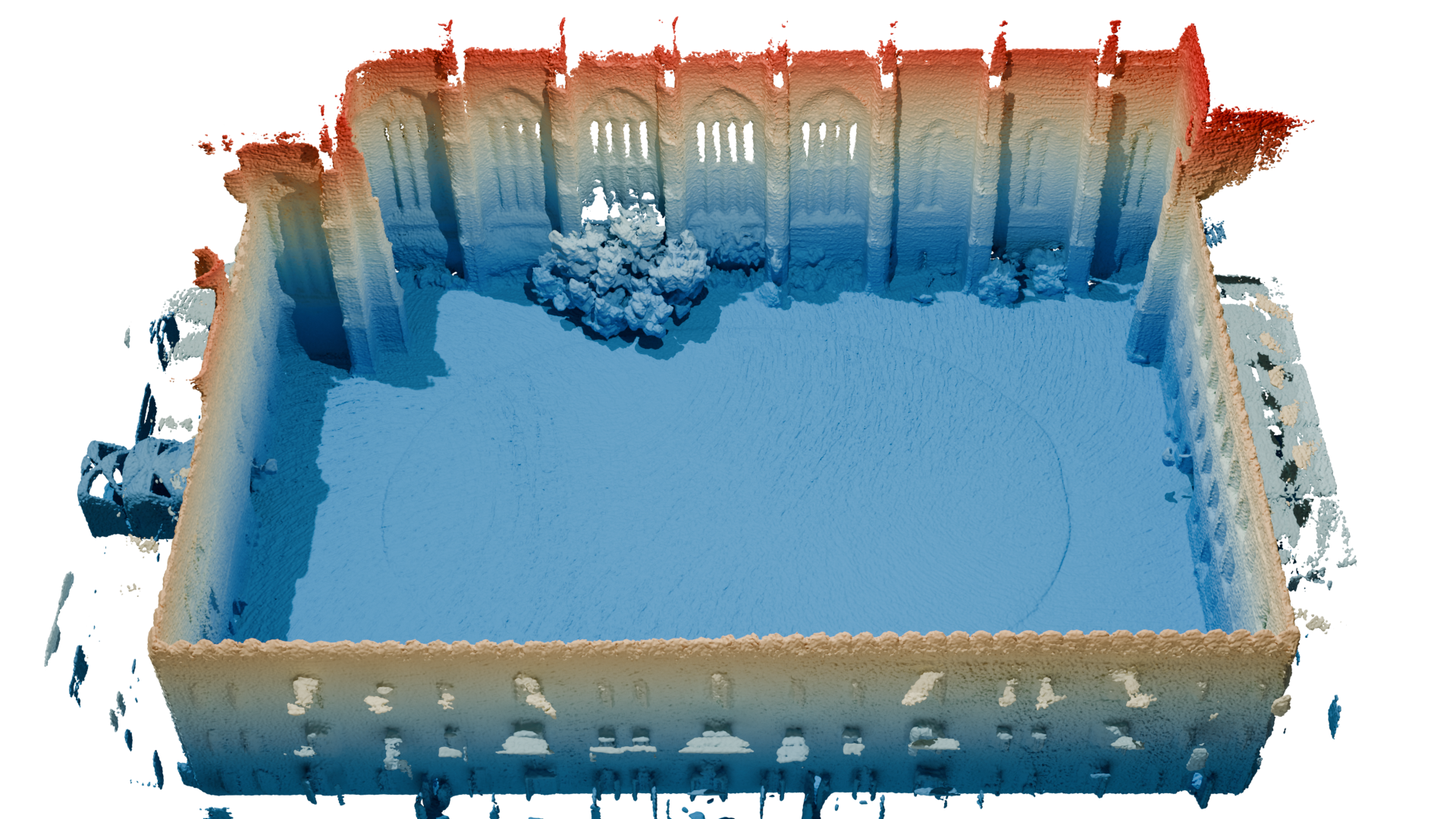
DB-TSDF is a high-efficiency, CPU-only framework for volumetric mapping. A directional bitmask-based integration scheme fuses each LiDAR return into the voxel grid with a single constant-time bitwise update, giving predictable per-scan runtime — independent of grid resolution — and high-fidelity reconstructions on platforms with limited GPU resources.
Method

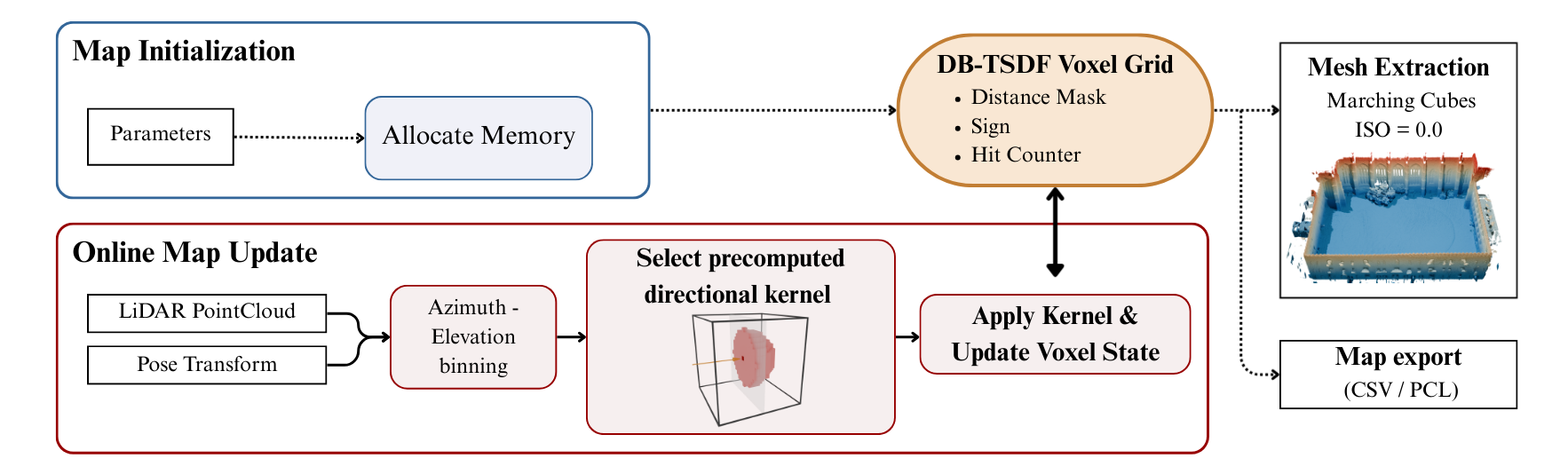
DB-TSDF integration pipeline diagram

Directional Kernels & Bitmask Encoding

Each LiDAR return selects a precomputed, direction-dependent kernel and updates the voxel's truncated distance mask with a single bitwise AND, while a hemispherical shadow region confirms occupancy via a saturating counter.

Kernel size and mask width are fixed, so the cost per return is constant and independent of grid resolution — and a compact, cache-friendly voxel layout keeps high-resolution, multi-threaded CPU mapping fast.

Directional Kernels

Each LiDAR return selects a precomputed kernel aligned to its azimuth/elevation, modeling beam geometry and occlusion directly in 3D.

Bitmask Distance Encoding

Truncated distances are stored as compact bitmasks updated with a single bitwise AND — a 16-bit layout keeps the per-voxel footprint at just a few bytes.

Constant-Time Updates

The cost of integrating each LiDAR return is fixed and independent of voxel grid resolution, giving predictable runtime even at high resolutions.

Multi-threaded CPU Pipeline

A cache-friendly, compact voxel layout and a multi-threaded C++/ROS 2 implementation deliver high-resolution reconstruction without relying on a GPU.

Results

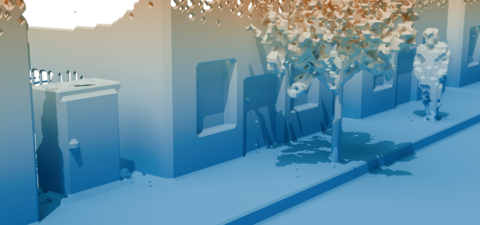
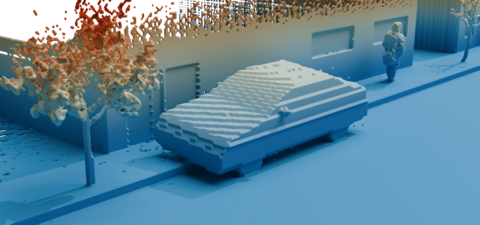
Benchmarked against state-of-the-art volumetric mapping methods on the Mai City and Newer College datasets, using the SHINE-Mapping evaluation pipeline.

96.6% Highest F-score on Mai City
~150 ms Constant runtime per LiDAR frame, 0.3–0.05 m voxel size
92.4% Recall on Newer College
8 bytes Memory footprint per voxel
20–40 ms per LiDAR scan
New · 16-bit version

The figures and tables above reflect the 32-bit variant evaluated in the paper (~150 ms/frame). The 16-bit version released in this repository is a newer, leaner iteration that runs in just 20–40 ms per scan.

Table I — Mai City dataset. Accuracy, Completeness and Chamfer-L1 in cm (lower is better); Recall and F-score at 10 cm in % (higher is better). Best result per column in bold, second-best underlined.
Method Acc. ↓ Comp. ↓ C-L1 ↓ Recall ↑ F-score ↑
VDB-GPDF3.88.56.283.388.7
Voxblox1.87.14.884.090.9
VDB Fusion1.36.94.590.294.1
PUMA1.232.016.978.887.3
SHINE-Mapping1.13.22.995.295.9
DB-TSDF (ours)1.74.63.193.696.6
Table II — Newer College dataset. Accuracy, Completeness and Chamfer-L1 in cm (lower is better); Recall and F-score at 20 cm in % (higher is better). Best result per column in bold, second-best underlined.
Method Acc. ↓ Comp. ↓ C-L1 ↓ Recall ↑ F-score ↑
VDB-GPDF7.511.99.791.790.4
Voxblox9.314.912.187.887.9
VDB Fusion6.912.09.491.392.6
PUMA7.715.411.589.991.9
SHINE-Mapping6.710.08.493.693.7
DB-TSDF (ours)9.110.79.992.491.3

Citation

If you use DB-TSDF in your research, please cite our paper:

BibTeX
@inproceedings{maese2026dbtsdf,
    title={DB-TSDF: Directional Bitmask-based Truncated Signed Distance Fields for Efficient Volumetric Mapping},
    author={Maese, Jose E. and Caballero, Fernando and Merino, Luis},
    booktitle={2026 IEEE International Conference on Robotics and Automation (ICRA)},
    year={2026}
}