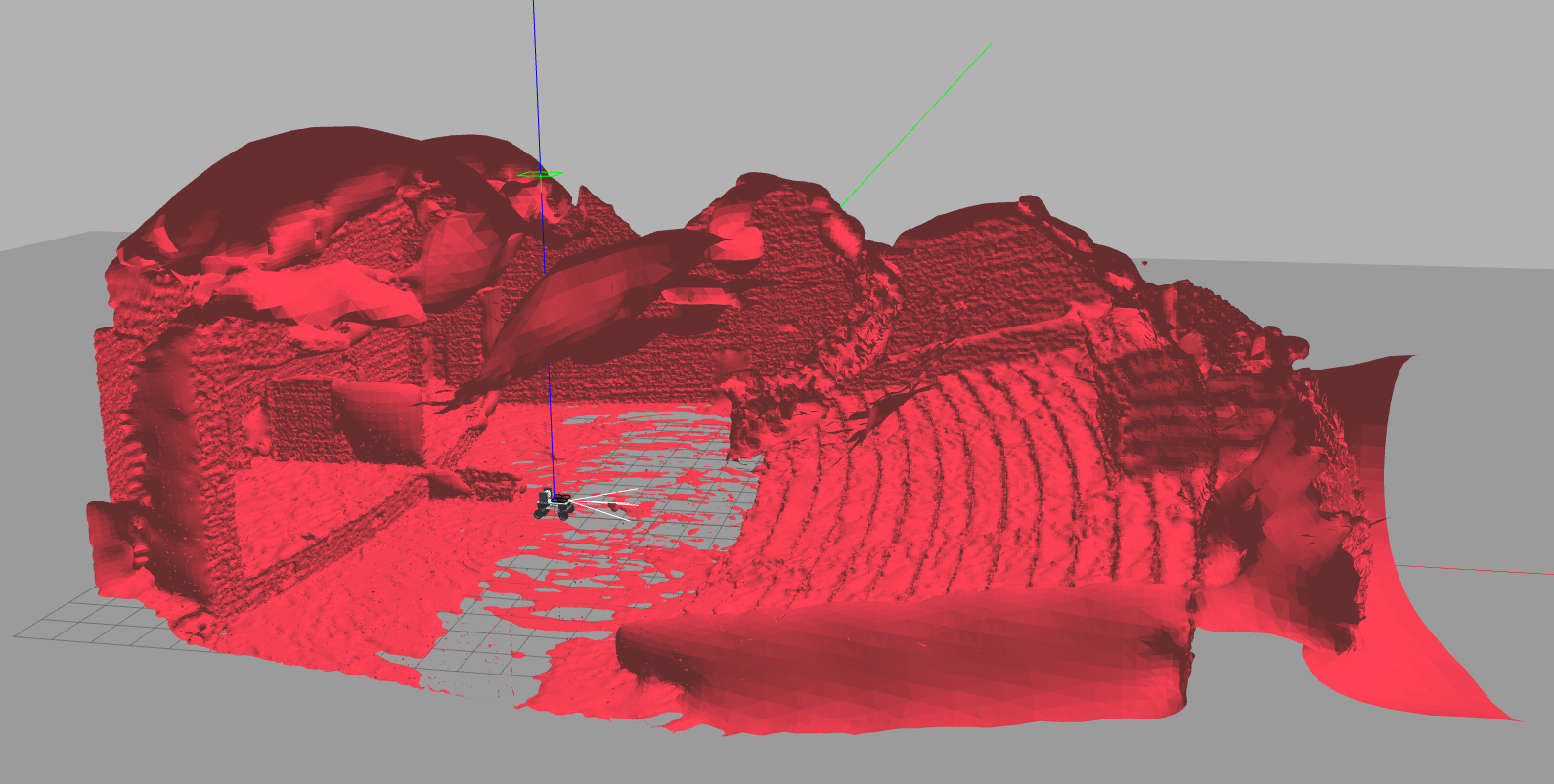
This work presents a simulation framework that models the dynamics of a
hanging tether with adjustable length connecting a UAV to a UGV, incorporating
the interaction between both robots and a winch. Extensive experiments,
including comparisons with real-world deployments, show that the simulation
closely reproduces the complex tether dynamics — particularly in constrained
environments — providing a validated tool for studying tethered robotic systems.
Simulator
The marsupial UAV-UGV simulator is built on ROS 2 Humble and
Gazebo, integrating multiple core components to simulate tethered robot behavior.
It supports both manual and autonomous operation, and is modular and easily customizable, allowing
modifications to the UAV, UGV, and tether models.
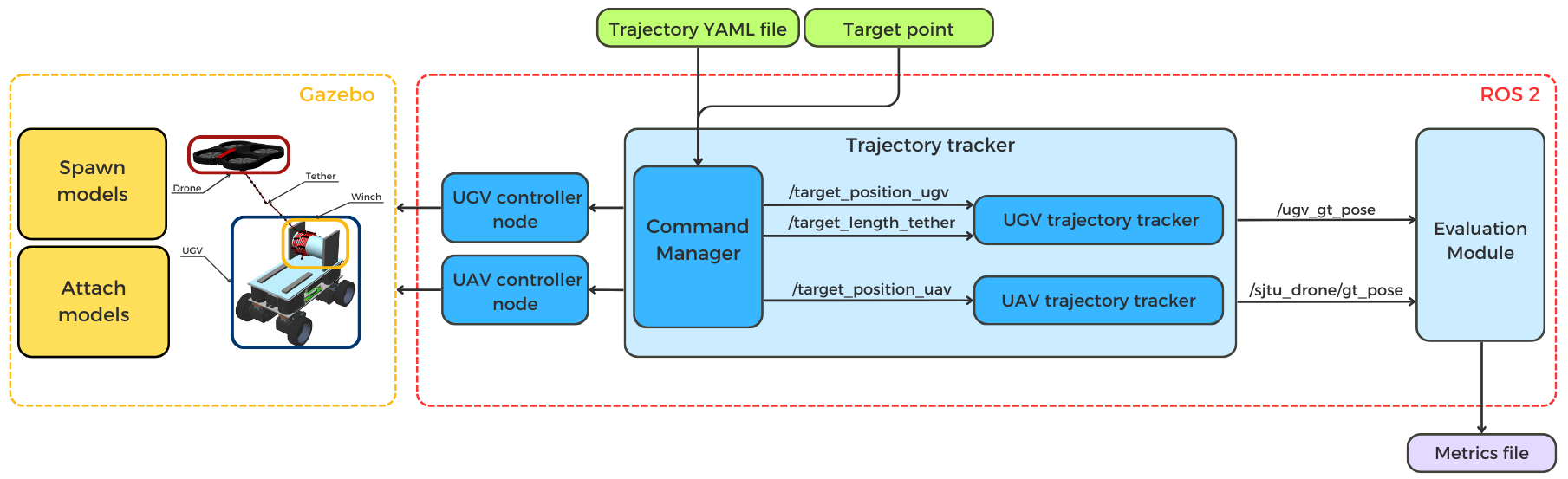
Architecture of the simulator: core modules (blue), base simulator modules (yellow),
input data (green) and output metrics (purple).
Model Initialization
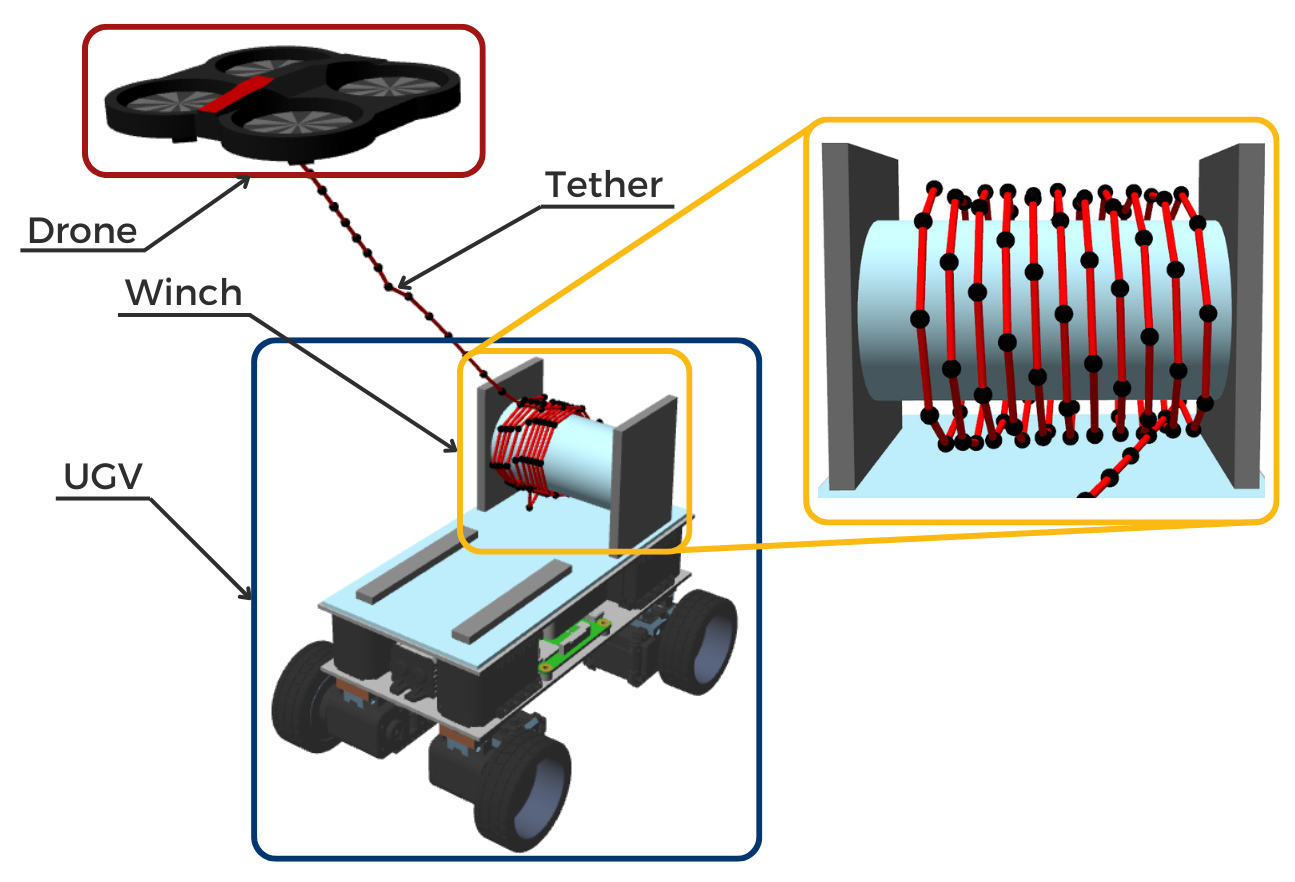
Gazebo spawns the UGV, the UAV on its landing platform, and a tether coiled around the winch.
The tether is attached to both robots and ROS 2 modules manage the system's operation.
Trajectory Tracking
Missions are specified via YAML waypoint files with reference tether lengths, or via real-time
ROS messages. Custom trajectory-tracking algorithms and control modules are supported.
Controllers
Each robot has a dedicated controller that executes the assigned movements. The UGV controller
also drives the winch, adjusting the tether length to maintain the proper slack.
Evaluation & Recording
An evaluation module collects ROS 2 topic data — robot poses and tether length variations — and
compiles metrics on trajectory accuracy, tether behavior, and system stability.
Models
UAV
Quadrotor with ROS 2-compatible position and velocity control, taking off from and landing on
the platform mounted on the UGV.
UGV & Winch
Holonomic ground vehicle with an integrated winch that dynamically releases and retracts the
tether during operation.
Tether
Flexible, multi-segmented tether with dynamic length adjustment. Length, mass, stiffness and
damping are fully configurable via a Jinja template.
Default parameters of the tether model. All values can be customized through the
tether.sdf.jinja template.
Parameter
Value
Units
Common Parameters
Radius of each section
0.004
m
Radius of the joint
0.009
m
Mass of each section
0.01
kg
Damping
0.05
Ns/m
Spring stiffness
0.01
N/m
Coiled Tether
Number of elements
125
–
Element length
0.15
m
Helix radius
0.14
m
Uncoiled Tether
Number of elements
10
–
Element length
0.05
m
Validation
Tether Model Evaluation
To validate the simulated tether against a real catenary, the UAV and UGV were placed 5, 10 and 15
meters apart with 20% tether slack, and the tether was simulated with four different element lengths.
The averaged error between the simulated tether elements and the theoretical catenary curve remains
below 1% of the tether length in all cases.
Averaged position error between the simulated tether and the theoretical catenary
for UAV-UGV separations of 5, 10 and 15 m (↓ lower is better).
Element Length (m)
err5 ↓ (%)
err10 ↓ (%)
err15 ↓ (%)
Mean ↓ (%)
0.05
0.942
0.268
0.269
0.493
0.10
0.332
0.214
0.232
0.259
0.15
0.675
0.323
0.292
0.430
0.20
1.600
0.490
0.552
0.881
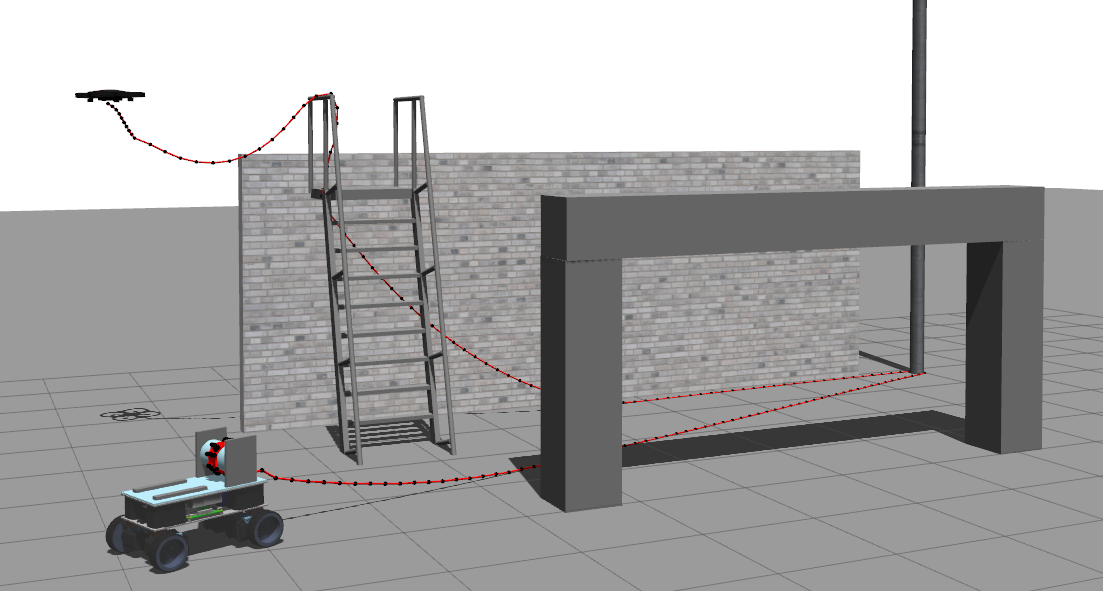
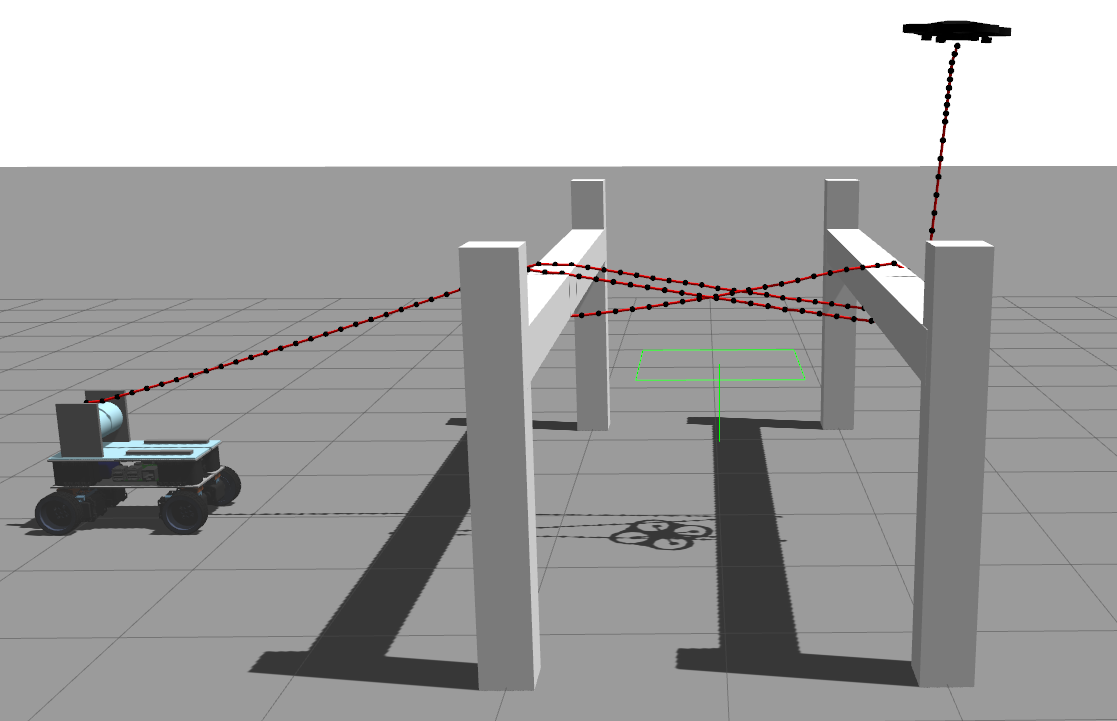
Beyond the catenary comparison, the tether interacts with the environment through Gazebo's physics
engine: it collides with obstacles, wraps around structures, and adjusts its tension in response,
affecting both the UAV's stability and the UGV's traction.
Collision with a hanging tetherCollision with a taut tether
Simulated Scenarios
Three predefined scenarios evaluate the fundamental functioning of the framework and the dynamics of
the UAV and UGV when following predefined trajectories, each repeated ten times.
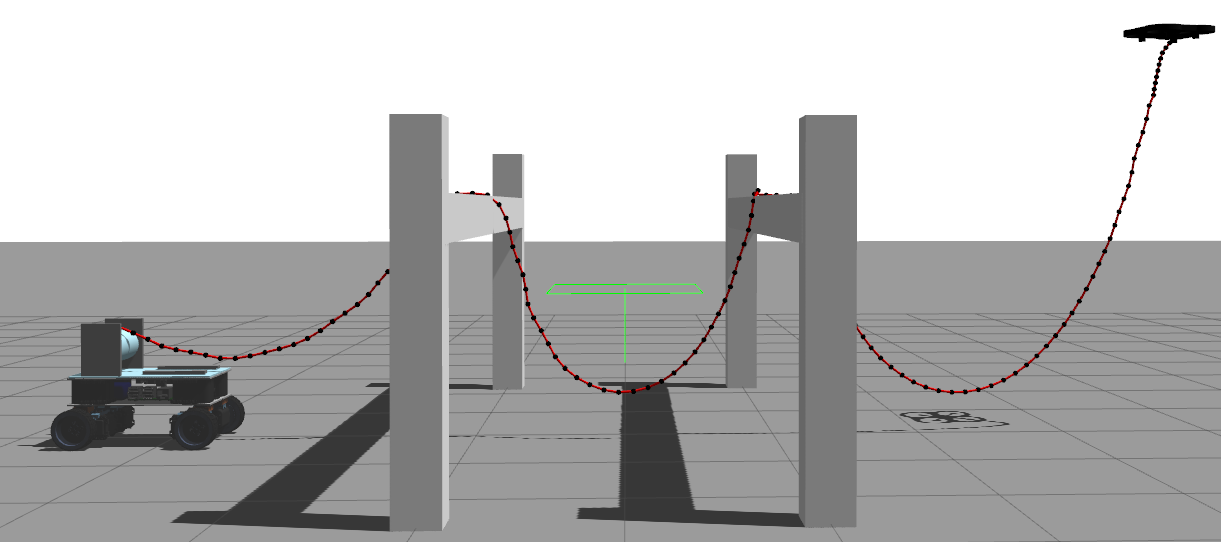
Examples of the simulated scenarios used for validation.
1 · Vertical Stability
The UGV remains stationary while the UAV performs ten consecutive ascents and descents,
evaluating the winch's ability to smoothly release and retract the tether.
2 · Horizontal Mobility
The UAV hovers at a fixed altitude while the UGV moves back and forth between two points,
testing tether slack management during horizontal displacement.
3 · Opposite Directions
UAV and UGV move simultaneously in opposite directions, challenging the coordination
mechanisms and the winch's dynamic tether-length adjustment.
Key metrics of the simulated scenarios: simulation time, targets reached, distance
traveled by each robot, and tether released/collected by the winch.
Scenario
Time (s)
Targets
Dist. UAV (m)
Dist. UGV (m)
Tether Rel. (m)
Tether Col. (m)
1
504
20
45.50
0.25
23.64
22.08
2
765
20
6.99
49.99
14.09
11.65
3
803
20
65.21
50.88
40.11
37.68
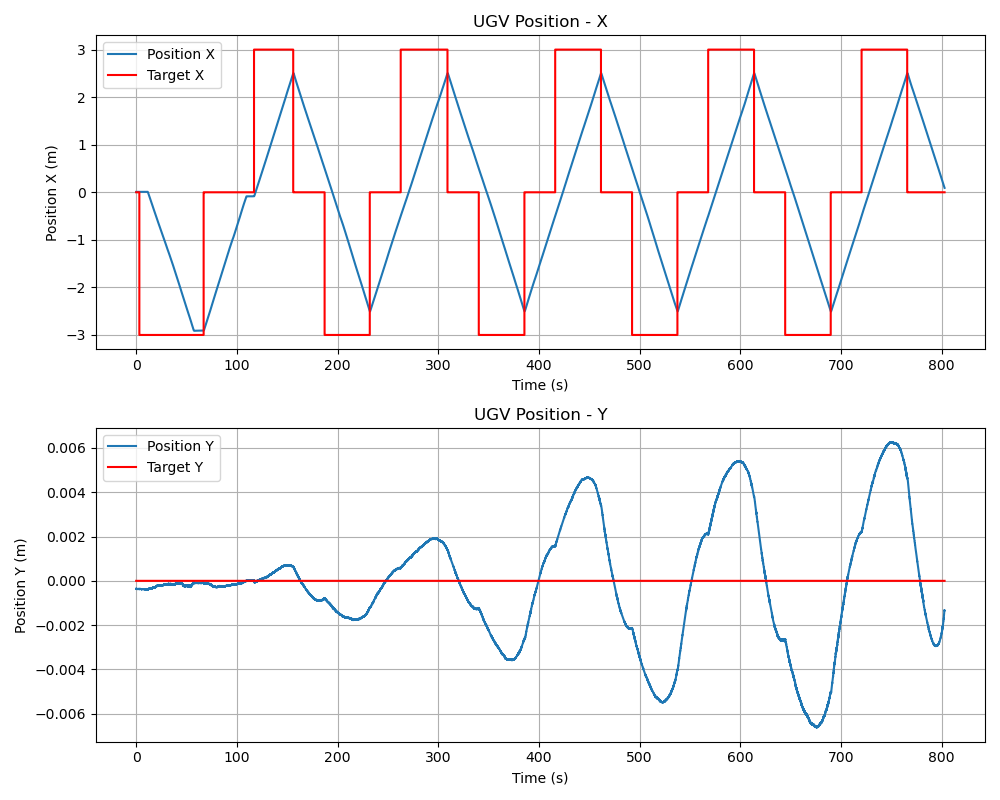
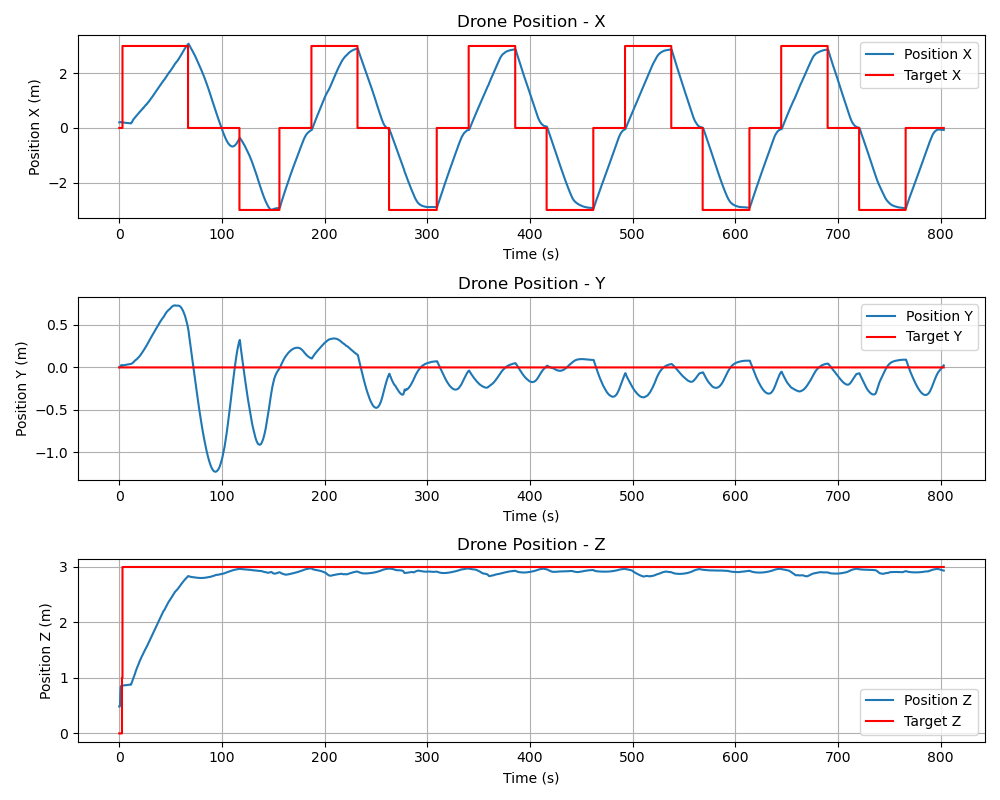
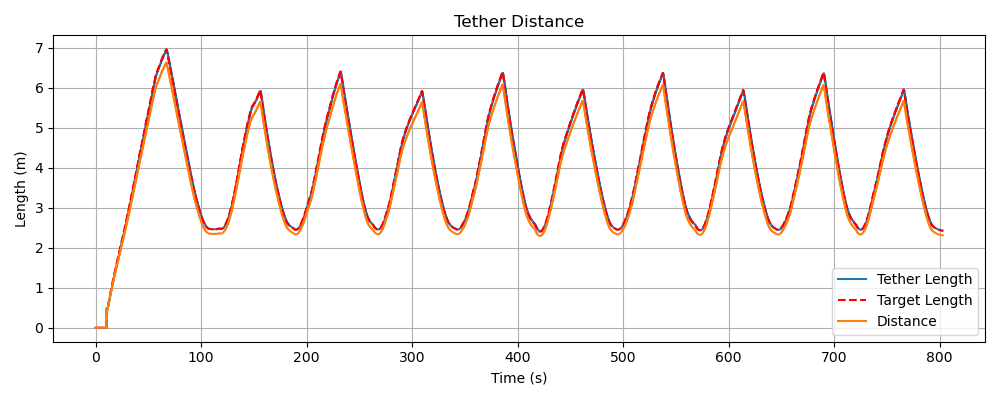
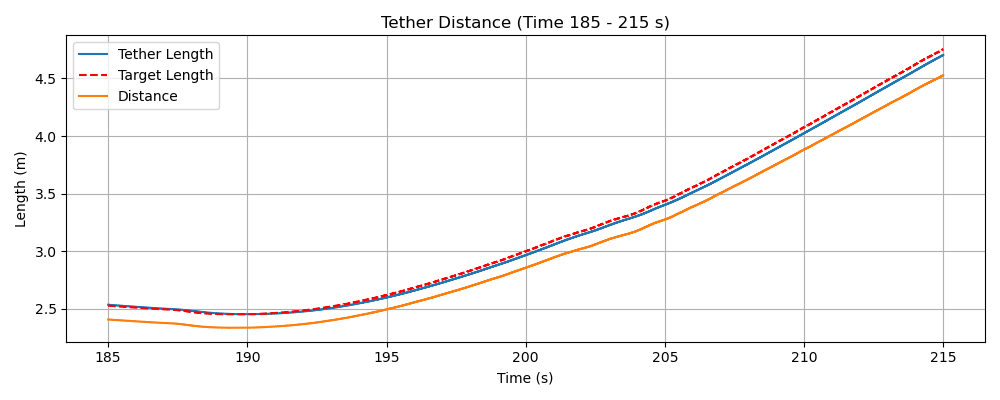
Detailed results for Scenario 3 (Opposite Direction Coordination): robot positions
with respect to their references, and tether length adjustments performed by the winch.
Robot PositionsTether Length
UGV position on each axis vs. referenceUAV position on each axis vs. reference
Tether length vs. target length and UAV-UGV distanceDetail of the tether length adjustment
The winch keeps the tether length 5% greater than the UAV-UGV distance, maintaining a slight slack.
Despite the dynamic forces introduced by the tether, the UAV successfully reached
all predefined target points, demonstrating the robustness of the control algorithms
and the tether management system.
Performance
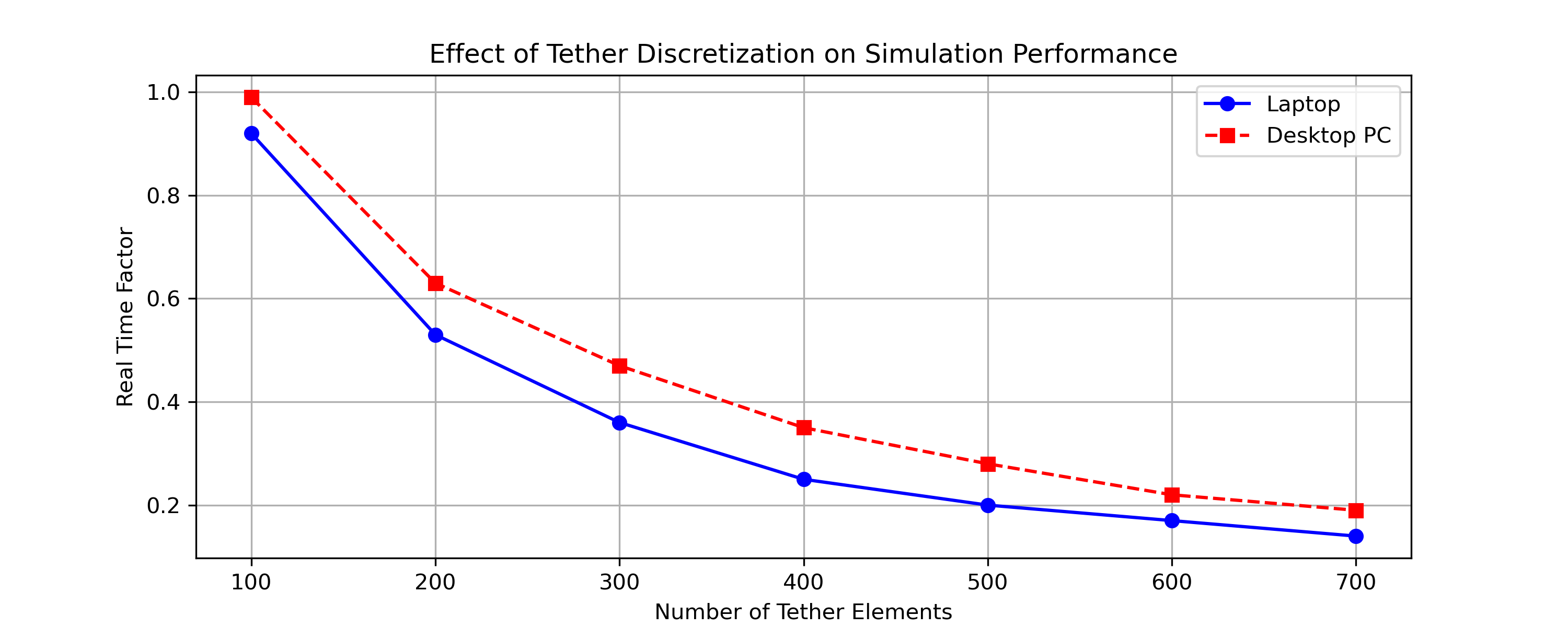
Computational performance was evaluated on a laptop (Intel i7-13620H, 32 GB RAM, RTX 4060) and a
desktop PC (Intel i9-12900F, 64 GB RAM, RTX 3060), averaging 10 runs per configuration. The number
of tether elements directly drives the computational load: the desktop maintains a real-time factor
from 0.99 (100 elements) down to 0.19 (700 elements), showing that the simulator runs on mid-tier
hardware while benefiting from higher-end systems for demanding configurations.
Real-time factor (RTF) for tether element counts ranging from 100 to 700.
Videos
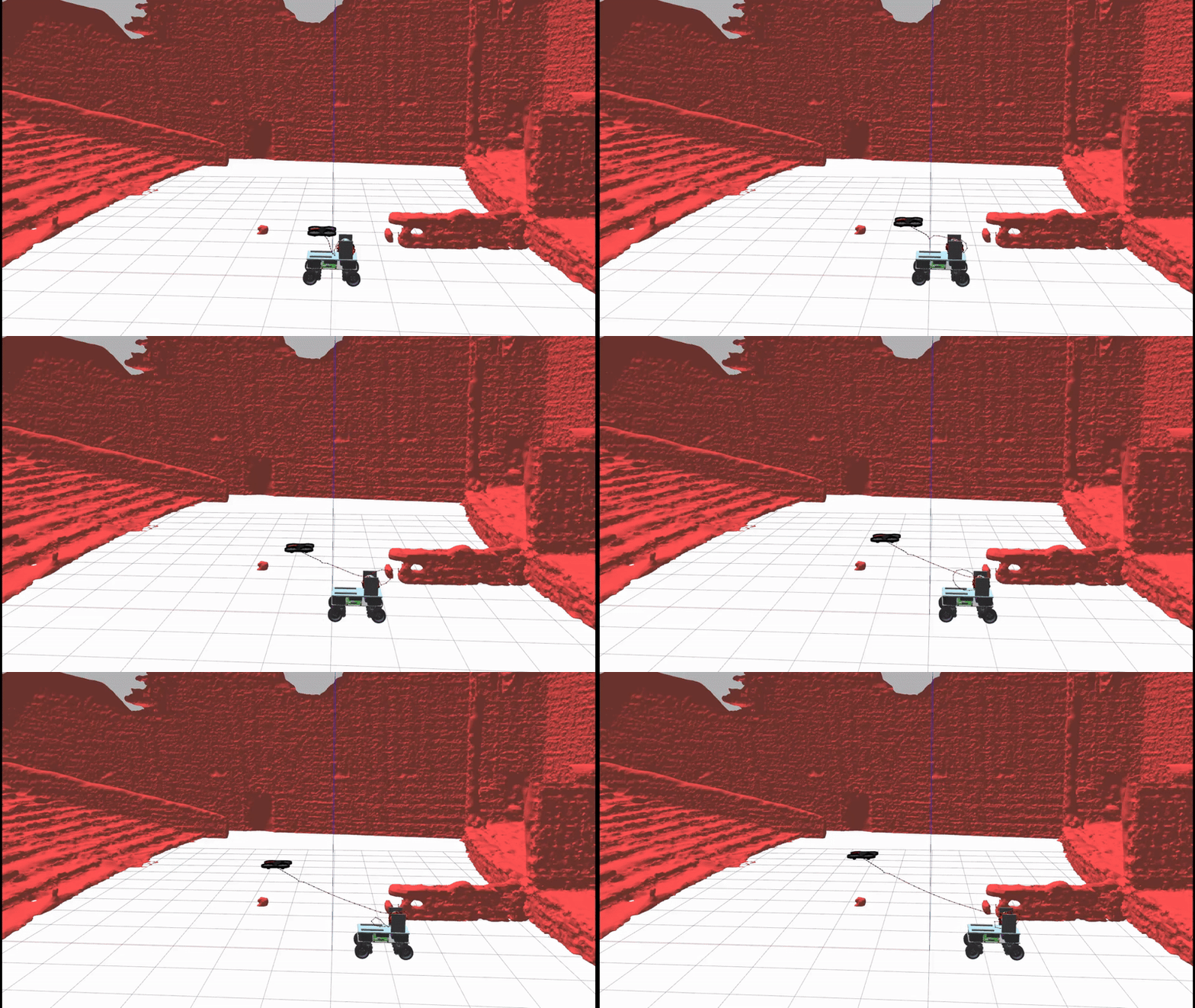
Side-by-side comparison with real-world experiments, and a closer look at tether-obstacle collisions.
Validation experiments
Tether-obstacle collisions
Citation
If you use this simulator in your research, please consider citing our
IEEE RA-P paper:
BibTeX
@article{maese2026marsupial,
    author  = {Maese, Jose E. and Caballero, Fernando and Merino, Luis},
    title   = {{Physical Simulation of Marsupial {UAV}-{UGV} Systems Connected by a Variable-Length Hanging Tether}},
    journal = {IEEE Robotics and Automation Practice},
    year    = {2026}
}